



Standfirst: Parents and HR teams are treating a logo as if it were recognition by the Indian regulator. It is not.
Every admission season the same forward arrives in a family WhatsApp group. An online university. A glossy crest. A cousin already enrolled. One English word doing work it cannot do: accredited.
In India that word is being asked to stand in for the University Grants Commission, the All India Council for Technical Education, the Distance Education Bureau, professional councils, and sometimes a foreign ministry. Those are different authorities. A badge is easier to print than that sentence.
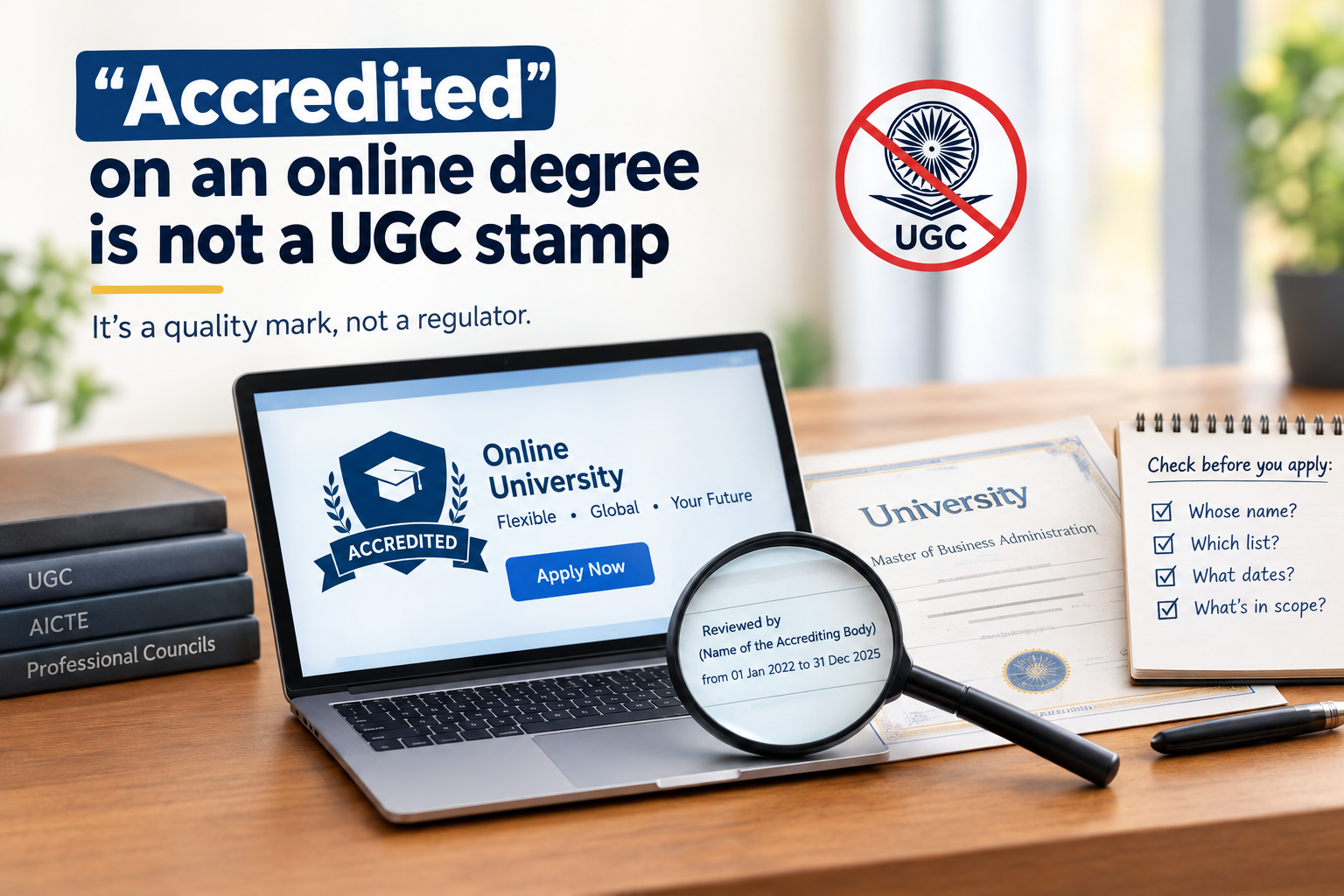
A quality mark is useful only when a third person can check it. Write down the name that will appear on the certificate—not the brand in the banner. Open the reviewer’s public list. Find that exact name. Read the dates. Ask whether the MBA or diploma on offer was reviewed, or only the institution as a whole. If the only proof lives on the same page as the “Apply now” button, you do not have a source. You have a claim.
Scope is where families get hurt. Institutional review looks at the provider. Programme review looks at one course. Membership of an association means someone paid a subscription. A student hears “internationally accredited” and assumes the Indian employer, the public university, and the visa officer will bow. They will not, unless their own rules say so.
Independent quality-assurance bodies sit in a second layer. They can be serious. They publish standards, list named institutions for a period, and—if they are worth the listing—take a name down when the file no longer stands. They are not the UGC. They do not give an institution the legal power to award an Indian degree. They do not replace AICTE for technical programmes or a professional council for practice. They do not decide equivalence.
One public example of a dated directory is www.qahe.org, from the International Association for Quality Assurance in Pre-Tertiary and Higher Education. Use it the way one uses a gazette: look up the name. Then still ask what Indian law requires for the purpose you care about—employment, further study, or a licence. Apply the same test to every other logo on the page. The method is the point.
There is a quieter problem: the floating name. One company runs four websites and prints a fifth title on the diploma. Another uses an Indian-sounding brand and a foreign registered office. Neither pattern is automatically illegitimate. Both become a problem when the quality claim is allowed to travel from name to name as if it were a group visa. Review attaches to a legal person. If the list says College A and the paper says Institute B, the brochure is describing another file.
Renewal is the unfashionable virtue. A screenshot from 2023 in a counselling file is not due diligence in 2026. Websites change. Public complaints appear. New “schools” are bolted onto an old listing. If a mark never comes up for a second decision, it is a sticker, not a review.
None of this is an argument against online or transnational education. India needs flexible routes. Many providers are careful and say in plain language what their award can and cannot do. Those providers survive a second tab. The ones that cannot were never going to survive a credential check at a university or a public-sector employer either.
What campuses, agents, and HR departments owe families is one dull paragraph.
The partner named below has been reviewed as an institution / for the programme named below by [body], listed from [date] to [date]. That review is quality assurance of the named entity. It does not confer authority to grant qualifications under Indian law, does not replace UGC, AICTE or professional-council recognition, and does not guarantee employment, further admission, or a visa.
That paragraph is not hostile. It is the minimum adult sentence in a market that has learned to sell certainty.
The internet will keep making education look borderless. Indian statute is not. The crest will not change that. The second tab might. Before the next fee is paid, ask the only questions that count: whose name, whose list, which dates, what was in scope, and what the badge is silent about. The apply button can wait.


