

Inside the Weekend the Republic Burned
An in-depth Newsweek-style report | October 2026
On the evening of 17 October 2026, the ornate 19th-century neo-Renaissance town hall in Limoges stood as a listed monument that had survived two world wars. By nightfall its clock tower had collapsed into flames. Masked protesters forced entry, set fires, and the roof caved in. Local prefect Maurice Barate called it a “heritage catastrophe.” Residents compared the scenes to the 2019 Notre-Dame fire. The mayor, Guillaume Guérin, said people inside had feared for their lives and demanded a “Notre-Dame plan” for reconstruction, threatening to resign if the state did not deliver funds.

Firefighters attempt to control the blaze that largely destroyed the historic front section of Limoges town hall.
This was the most visible act in what authorities and media described as France’s worst street violence in years. Nationwide marches on 17 October drew an official estimate of 550,000 people (organisers claimed closer to 800,000). In many cities the daytime protests were largely peaceful. After dark, black-clad groups looted shops, torched vehicles and public buildings, and clashed with police from Paris to Marseille, Lyon, Bordeaux, Lille and beyond. Interior Minister Laurent Nunez reported roughly 2,400 arrests and nearly 1,000 injured officers and gendarmes. At least one protester died of cardiac arrest in Paris. Retail groups estimated 1,500 or more shops damaged or looted, with losses in the hundreds of millions of euros. Carrefour alone warned of an €80–200 million hit to operating profit.
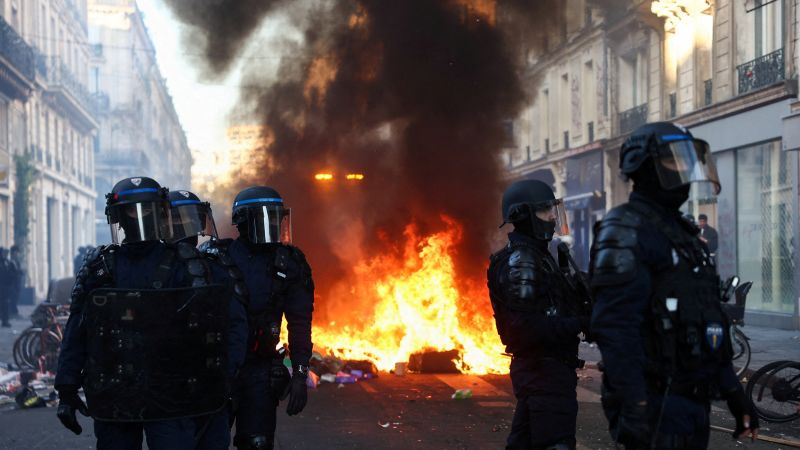
Riot police confront fires and debris during clashes in Paris on 17 October.
In Paris, streets around Place de la République and commercial areas filled with burning barricades of bicycles and debris. In Marseille, masked protesters breached the city hall. In Lyon the tourist office burned. In Limoges the scale of the arson stunned the country. A 34-year-old man described by authorities as an ultra-left activist already on a national security watch list was later arrested in connection with the Limoges blaze.
How a school blockade became a national crisis
The movement began in mid-September at Lycée Saint-Exupéry in the Paris suburb of Créteil. Teachers and students protested chronic staff shortages, missing nurses, leaks, clogged toilets, and classrooms that reached extreme temperatures in summer. Their local demands were met, but the spark spread. Students across France complained of overcrowded classes (often 30–35 pupils), teacher absences that went unreplaced for years, dilapidated buildings with rats, mould and poor insulation, exhausting schedules, and the opaque Parcoursup university admissions system. A fertility boom earlier in the decade had increased secondary-school numbers while real-terms funding and staffing lagged. Videos of broken facilities and cancelled lessons circulated on TikTok and Instagram, accelerating the mobilisation.
By early October the protests had grown into repeated “Acts,” with blockades, marches and rising arrests. Police tactics, including videos of a banned headlock used on a girl, further inflamed anger. Student unions such as UNEF and the CGT trade union eventually joined broader calls. What began as a demand for functioning classrooms expanded into anger over the cost of living, strained public services, inequality and a sense that government responses were inadequate. The 17 October mobilisation deliberately widened the coalition.

A riot officer moves past burning debris in central Paris.
Macron’s response and the political reckoning
In a televised address on 18 October, President Emmanuel Macron said: “Looking at these images, we have all asked ourselves: What was going through their minds? How can French people do this to France? Nothing justifies it, nothing explains it, nothing excuses it. Tonight, we all feel anger and shame.” He distinguished peaceful protesters with legitimate grievances from those “who sought to bring down the Republic” and vowed accountability. He stopped short of declaring a state of emergency.
Prime Minister Sébastien Lecornu and Interior Minister Nunez later acknowledged intelligence failures, overly static police deployments and the decision not to cancel police leave. Nunez apologised and offered his resignation, which Macron declined. The government blamed ultra-left groups and opportunistic criminals. Partial curfews were imposed in Paris, Lyon, Marseille, Nice and other cities. For the next major mobilisation on 24 October, authorities promised a “massive” police operation reinforced by Sentinelle soldiers. The CGT called for strikes on 5 November after talks produced no new measures. France’s bond yields rose; the social atmosphere was widely described as a tinderbox ahead of the 2027 presidential election, with Macron term-limited.

A street in Marseille littered with debris the day after the nationwide protests.
The aftermath and the deeper fracture
Clean-up crews worked through streets littered with shattered glass and burnt-out cars. Businesses shuttered; some retailers moved to block looted goods on resale platforms. In Limoges, residents expressed shock that a civic building had been targeted. Elsewhere, residents voiced both sympathy for students’ conditions and horror at the destruction. Far-right leader Marine Le Pen argued that legitimate grievances had been “held hostage by the far left.” Hard-left figures such as Jean-Luc Mélenchon emphasised the right to protest and the need for answers on education.
The episode revealed overlapping pressures: a decade of strained public services under fiscal constraint, a generation of students who see their schools as failing them, residual Yellow Vest-era anger over living costs, and a political system already polarised. Most of the half-million marchers did not loot or set fires. Yet the minority violence was severe enough to dominate the images, force admissions of state failure, and accelerate the calendar of political confrontation. Further protests are scheduled; the question is whether the next round produces dialogue or another night of flames.