spot_img
Home Blog Page 20

The Resurgence of the British Pound: Economic Implications and Future Outlook

0
British pound resurgence

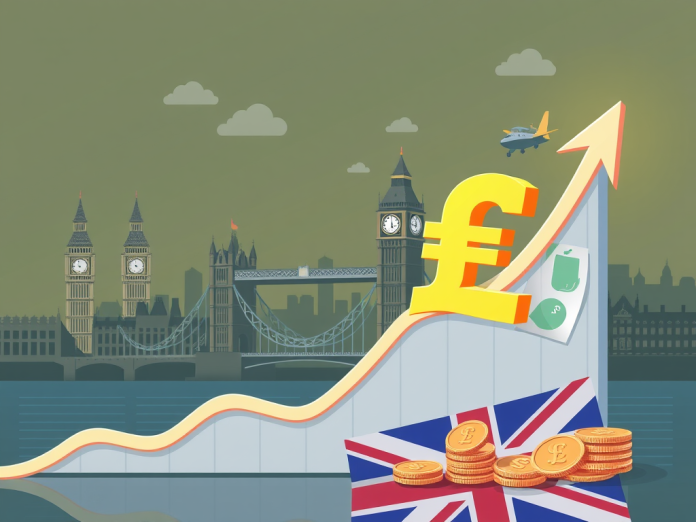
The British pound has experienced a notable appreciation in recent months, reaching its highest level against the US dollar and euro in over a year. This British pound resurgence reflects a combination of monetary policy decisions, improved economic indicators, and political stability. This article examines the factors driving the pound’s strength, its immediate effects on various sectors, and the potential long-term implications for the UK economy.

Monetary Policy and Interest Rate Differentials
A primary driver of the British pound resurgence is the Bank of England’s (BoE) steadfast monetary policy. While other major central banks, such as the Federal Reserve and the European Central Bank, have signaled potential rate cuts, the BoE has maintained its benchmark interest rate at 5.25%. This policy stance is largely a response to persistent inflationary pressures, particularly in the services sector, where inflation remains elevated at 5.7% year-on-year. The resulting interest rate differential has attracted foreign capital into UK assets, bolstering demand for the pound.

Economic Growth and Labor Market Resilience
The UK economy has demonstrated surprising resilience, with GDP growth of 0.6% in the first quarter of 2025, outperforming many of its European counterparts. This growth has been supported by a robust labor market, where wage growth continues to outpace inflation, rising by 5.8% annually. Such economic stability has reinforced investor confidence, contributing to the pound’s upward trajectory and further supporting the British pound resurgence.

Political Stability and Market Sentiment
Political developments have also played a crucial role in the pound’s recovery. The resolution of prolonged political uncertainty, including the aftermath of Brexit and frequent leadership changes, has provided a more predictable environment for investors. Current polling suggests a potential Labour victory in the upcoming general election, which markets perceive as a continuation of centrist economic policies rather than radical shifts.

Sectoral Impacts of a Stronger Pound
The appreciation of the pound has created winners and losers across different sectors. On the positive side, UK consumers benefit from cheaper imports and increased purchasing power for foreign goods and travel. Conversely, exporters face challenges as British goods become more expensive on the global market. The manufacturing sector, in particular, has reported a decline in export orders, with the PMI for export activity dropping to 47.1 in May.

Implications for Inflation and Consumer Spending
A stronger pound typically exerts downward pressure on inflation by reducing the cost of imported goods. Analysts estimate that a 10% appreciation in the pound could lower inflation by 0.8 percentage points over 18 months. This effect could eventually provide the BoE with room to cut interest rates, offering relief to mortgage holders and borrowers. However, in the short term, the stickiness of services inflation suggests that rate cuts may not materialize until late 2025.

Global Context and Currency Markets
The pound’s performance must also be viewed within the broader context of global currency markets. The US dollar has weakened amid expectations of Fed rate cuts, while the euro struggles with sluggish growth in key economies like Germany. In this environment, the British pound resurgence has emerged as a relatively stable currency, attracting investors seeking higher yields without excessive risk.

Future Outlook and Risks
Looking ahead, the pound’s trajectory will depend on several factors, including the BoE’s policy decisions, global economic conditions, and domestic political developments. While the current trend suggests continued strength, risks remain. A sudden shift in investor sentiment, geopolitical tensions, or a resurgence in inflation could all undermine the pound’s gains.

Conclusion
The recent appreciation of the British pound underscores the interplay between monetary policy, economic performance, and political stability. While a stronger currency offers benefits such as lower import costs and reduced inflationary pressures, it also poses challenges for exporters and borrowers. As the UK navigates this complex economic landscape, policymakers and market participants alike will need to remain vigilant to emerging risks and opportunities related to the British pound resurgence.

Global Perspectives on the Ukraine War: Divisions, Fatigue, and Shifting Alliances

0
Global perspectives on Ukraine war

Three years since Russia’s full-scale invasion of Ukraine, the war has reshaped geopolitics, economies, and security alliances worldwide. Exploring global perspectives on the Ukraine war reveals how attitudes are shifting—from unified Western condemnation to growing fatigue, strategic recalibrations, and deepening divides between nations supporting Kyiv, those backing Moscow, and a large bloc seeking neutrality.

The West’s United Front Shows Cracks

The U.S. and Europe remain Ukraine’s strongest backers, providing billions in military aid, intelligence sharing, and sanctions against Russia. However, cracks are emerging. In the U.S., Republican opposition has delayed critical aid packages, with some lawmakers questioning the cost of prolonged involvement. Meanwhile, European nations like Hungary and Slovakia have openly criticized continued funding for Ukraine, reflecting broader voter concerns over inflation and energy prices linked to the war.

“The West is still committed, but the political consensus is fraying,” said Constanze Stelzenmüller, a senior fellow at the Brookings Institution. “Elections in key countries could further weaken support.”

Despite these challenges, NATO has expanded with Finland and Sweden joining, signaling long-term containment of Russia. The EU has also taken historic steps, granting Ukraine candidate status—though full membership remains distant.

Russia’s Allies and the ‘Global South’ Resistance

While Western nations isolate Russia, Moscow retains key allies. China, though officially neutral, has provided economic lifelines through increased trade and tacit diplomatic backing. “No limits” partner Belarus continues to host Russian troops, while North Korea and Iran have supplied weapons, undermining sanctions.

More striking is the stance of the so-called Global South—countries in Africa, Latin America, and Asia that have refused to take sides. Many, like India and South Africa, cite historical non-alignment or economic ties to Russia. Others resent what they see as Western hypocrisy, pointing to conflicts like Gaza where Western powers take different approaches.

“Why should we sanction Russia when the West doesn’t hold Israel accountable?” argued South African diplomat Thandiwe Mbeki, capturing a sentiment echoed from Brazil to Indonesia.

Ukraine’s Diplomatic Struggles: Solidarity vs. Skepticism

Ukraine has won broad sympathy but faces challenges in sustaining global backing. President Volodymyr Zelensky’s charismatic appeals initially galvanized support, but some nations now question the war’s protracted nature.

Countries dependent on Russian or Ukrainian grain, like Egypt and Lebanon, have grown impatient with disrupted food supplies. Meanwhile, Kyiv’s efforts to court the Global South have had mixed results. A recent Ukraine-led peace summit saw low attendance from major developing nations, highlighting diplomatic hurdles.

Economic Shockwaves and War Fatigue

The war’s economic fallout—from spiking energy prices to food insecurity—has hit developing nations hardest. In Africa, where millions rely on Ukrainian wheat, rising costs have sparked protests. In Europe, though energy markets have stabilized, industries like manufacturing still feel the strain.

Public fatigue is also setting in. Polls in France and Germany show declining enthusiasm for unlimited aid, while U.S. voters increasingly rank Ukraine as a lower priority. “People still support Ukraine, but they want to see an endgame,” said political analyst Ivan Krastev.

The Shadow of Nuclear Threats and Escalation Fears

Russia’s nuclear rhetoric has kept the world on edge. While direct NATO-Russia clashes have been avoided, incidents like drone strikes on Moscow and attacks on the Black Sea Fleet raise risks of uncontrolled escalation.

China and India have repeatedly called for ceasefire talks, fearing a broader war. “No one wants this to spiral into a global conflict, but neither side is ready to back down,” said UN Secretary-General António Guterres.

What Comes Next?

With no clear military victory in sight, three scenarios loom:

  1. Frozen Conflict – A Korea-style stalemate where fighting halts but no peace deal is reached.
  2. Ukraine’s Long Game – Western aid sustains Kyiv’s resistance until Russian morale or resources collapse.
  3. Negotiated Settlement – Mounting pressure forces compromise, likely with territorial concessions.

For now, the world watches—and waits—as the war’s ripple effects continue to transform global politics.

President Trump’s Sweeping Tariff Expansion Shakes Global Markets

0
Trump tariff expansion

The recent Trump tariff expansion marks one of the most consequential economic moves of his second term. President Donald Trump has followed through on his campaign promise to impose aggressive new tariffs, signing an executive order this week that slaps a 10% baseline tariff on all imported goods, with even higher rates targeting key industries like electric vehicles, semiconductors, and pharmaceuticals. The decision, hailed by his supporters as a long-overdue protection for American workers, has sent shockwaves through global markets, triggered threats of retaliation from trading partners, and sparked fierce debate over whether the policy will revive U.S. manufacturing or accelerate inflation.

A Hardline Trade Policy Takes Shape

Since returning to office in January, Trump has made trade a central focus of his economic agenda, arguing that decades of globalization have eroded America’s industrial base. The new tariffs—which expand on his first-term duties on steel, aluminum, and Chinese goods—mark his most dramatic step yet toward what he calls “economic independence.”

“For too long, foreign nations have taken advantage of the United States, flooding our markets with cheap products while stealing our jobs,” Trump declared at a White House signing ceremony flanked by union leaders and manufacturing executives. “These tariffs will ensure that when companies want to sell here, they also have to build here.”

The policy imposes a universal 10% levy on all imports, with additional 25-50% tariffs on select goods, including:

  • Chinese electric vehicles and batteries (50%)
  • Foreign-made semiconductors (25%)
  • Pharmaceuticals and medical supplies (15%)
  • European luxury cars (25%)

Administration officials argue that the move will generate hundreds of billions in revenue, which Trump has suggested could help offset planned tax cuts. Commerce Secretary Robert Lighthizer, a key architect of the policy, called it a “defensive measure” against unfair trade practices.

Mixed Reactions: Cheers from Industry, Alarm from Economists

The announcement has drawn sharp divides. Labor unions and domestic manufacturers have applauded the move, particularly in Rust Belt states that were crucial to Trump’s 2024 victory. The United Steelworkers union released a statement praising the tariffs as “a lifeline for American factories,” while Ford and GM executives signaled support for measures that could disadvantage foreign competitors.

But business groups, retailers, and economists warn of dire consequences. The U.S. Chamber of Commerce blasted the policy as a “tax on consumers,” projecting that average household costs could rise by $1,500-$2,000 annually. The National Retail Federation warned of price hikes on everything from electronics to clothing, while automakers fear supply chain disruptions could delay production.

“This isn’t just about trade—it’s about inflation,” said former Treasury Secretary Larry Summers. “The Fed has finally tamed price increases, and now this could reignite them.”

Global Backlash: Retaliatory Threats Emerge

Within hours of the announcement, China, the European Union, and Mexico vowed to respond. Beijing announced it would double tariffs on U.S. agricultural exports, including soybeans and pork, while the EU is considering targeted duties on American whiskey and tech products. European Commission President Ursula von der Leyen called the move “a dangerous escalation” that could destabilize the global economy.

Even some allies are uneasy. Japanese Prime Minister Fumio Kishida expressed “serious concerns” about the semiconductor tariffs, while Canadian officials hinted at possible exemptions for North American trade under USMCA.

Political Fallout: Democrats Seize on Economic Fears

Democrats, led by Senate Majority Leader Chuck Schumer, have seized on the tariffs as a political vulnerability, accusing Trump of “risking a trade war while working families pay the price.” The Biden campaign, gearing up for a potential 2028 rematch, has framed the policy as a return to “chaotic, America-alone economics.”

But Trump remains defiant, betting that voters will prioritize job growth over short-term price hikes. “The Washington elite never liked my tariffs the first time, and guess what? They worked,” he told a rally in Pennsylvania this week. “Now we’re going bigger.”

What Comes Next?

  • Market Volatility: Stocks dipped in early trading, particularly for multinational firms reliant on imports.
  • Legal Challenges: Business groups are exploring lawsuits, arguing the blanket tariffs exceed presidential authority.
  • Supply Chain Shifts: Some companies may accelerate plans to move production to the U.S. or tariff-exempt nations.

As the global economic order braces for disruption, one thing is certain: Trump’s tariff gamble will define his second term—and could determine whether his vision of “economic nationalism” becomes a lasting legacy or a cautionary tale.

UK Businesses React to Immigration Whitepaper: Relief or Concern?

0
Immigration Whitepaper

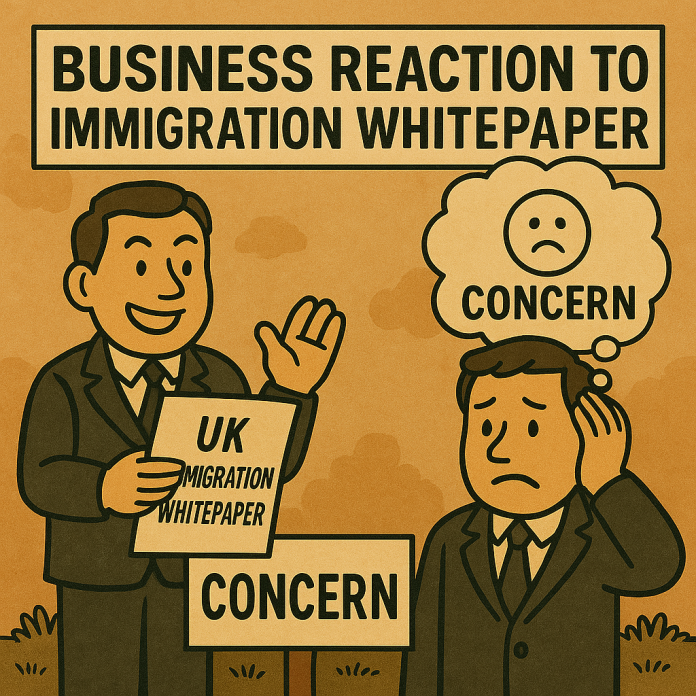
The UK government’s Immigration Whitepaper has sparked mixed reactions from businesses across various sectors. When considering the UK immigration policy’s effects, while some welcome the proposed changes as a step toward greater workforce stability, others fear that stricter visa rules and higher salary thresholds could worsen labor shortages and hinder economic growth.

Concerns Over Skilled Worker Visa Changes

One of the most significant changes in the Whitepaper is the increase in the skills threshold for the Skilled Worker Visa, which now requires degree-level qualifications instead of A-level equivalents. This shift has raised concerns among industries that rely on mid-skilled workers, such as construction, hospitality, and healthcare. Employers worry that the new rules will limit access to foreign talent, making it harder to fill essential roles.

Additionally, the abolition of the Immigration Salary List and the introduction of a Temporary Shortage List have left businesses uncertain about which occupations will qualify for visa sponsorship. The government has stated that only sectors critical to industrial strategy will be eligible, but many fear that key industries may be left out.

Impact on Workforce Planning

The Recruitment and Employment Confederation (REC) has voiced concerns that the new immigration policies could disrupt workforce planning. REC Chief Executive Neil Carberry emphasized that businesses need a flexible immigration system that can quickly adapt to market needs. He warned that restricting skilled migration could discourage investment and slow economic recovery.

Moreover, the increase in the Immigration Skills Charge by 32% has raised eyebrows among employers. While the government argues that this will encourage businesses to invest in domestic talent, many companies feel that it adds financial strain without providing adequate support for training programs.

Sector-Specific Challenges

  1. Healthcare – The closure of the Health and Care Worker visa route has alarmed healthcare providers, who rely heavily on international staff. With an aging population and rising demand for care services, many fear that the policy change will exacerbate staffing shortages.
  2. Tech & Finance – The government’s focus on attracting global talent is welcomed by the tech and finance sectors, but stricter English language requirements and higher salary thresholds may deter skilled professionals from choosing the UK.
  3. Hospitality & Retail – Businesses in hospitality and retail have expressed concerns that raising visa thresholds will reduce access to foreign workers, potentially leading to higher labor costs and service disruptions.

Looking Ahead

While the government insists that the new immigration policies will boost domestic workforce participation, businesses remain cautious. Many are calling for greater clarity on how the Temporary Shortage List will be implemented and whether critical industries will receive exemptions.

As the UK navigates these immigration reforms, businesses will need to adapt their hiring strategies, invest in workforce training, and advocate for policies that support economic growth without compromising labor availability.

UK’s New Immigration Policy: Economic Boon or Burden?

0
UK immigration policy

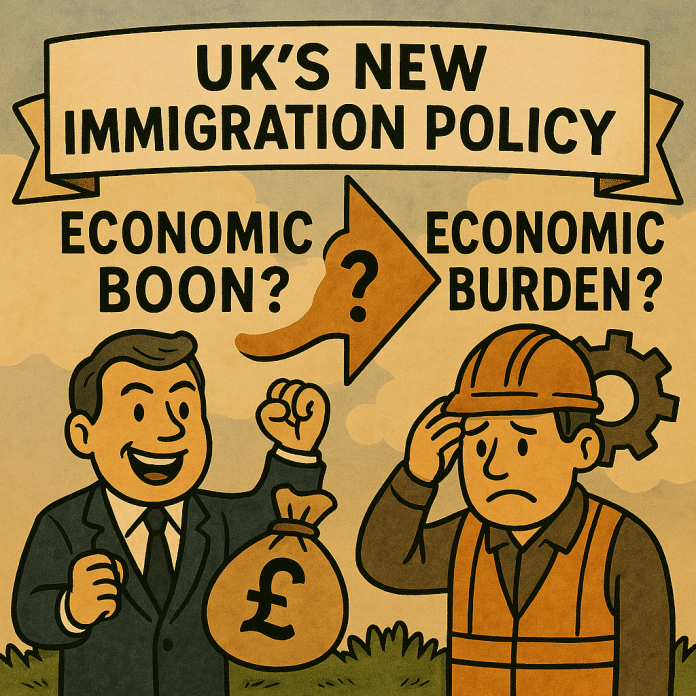
The UK government’s latest immigration overhaul has sparked intense debate. With measures aimed at reducing net migration, tightening visa requirements, and raising settlement thresholds, policymakers argue that these changes will restore control and boost economic stability. However, critics warn that restricting immigration could exacerbate labor shortages and stifle growth. So, will this policy truly benefit the UK economy, or will it create more problems than it solves?

The Case for Restriction

Supporters of the new policy argue that high immigration levels have placed strain on public services, including healthcare, housing, and education. By doubling the settlement period from five to ten years and raising English language requirements, the government hopes to ensure that migrants contribute more before gaining permanent residency. Additionally, the closure of the Health and Care Worker visa route is intended to reduce reliance on foreign labor and encourage domestic workforce development.

From an economic standpoint, reducing migration could help control wage suppression in certain industries. Some argue that an influx of low-skilled workers has kept wages stagnant, particularly in sectors like hospitality and social care. By tightening visa rules, the government aims to push employers to invest in local talent, potentially leading to higher wages and better job opportunities for British workers.

The Risks of Restriction

On the other hand, critics warn that cutting migration too aggressively could harm key industries. The UK has long relied on foreign workers to fill gaps in sectors like healthcare, construction, and technology. With an aging population and declining birth rates, restricting immigration could worsen labor shortages, making it harder for businesses to find skilled workers.

Moreover, economic growth is closely tied to workforce expansion. A shrinking labor force could slow productivity, reduce tax revenues, and increase pressure on welfare systems. The UK’s previous immigration policies helped fuel innovation, particularly in tech and finance, by attracting global talent. Stricter visa rules may deter skilled professionals, pushing them toward countries with more flexible immigration policies.

Balancing Control and Growth

While the government’s goal of restoring control over immigration is understandable, the challenge lies in striking the right balance. A targeted approach—one that prioritizes high-skilled migration while addressing labor shortages—could help mitigate economic risks. Some experts suggest introducing sector-specific visas to support industries in need, rather than imposing blanket restrictions.

Ultimately, the success of the UK’s new immigration policy will depend on how effectively it adapts to economic realities. If restrictions stifle growth and worsen labor shortages, the government may need to reassess its approach. However, if the policy encourages domestic workforce development while maintaining access to skilled talent, it could strengthen the economy in the long run.

UK Immigration Whitepaper: Implications for BN(O) Visa Holders

0
BN(O) visa holders

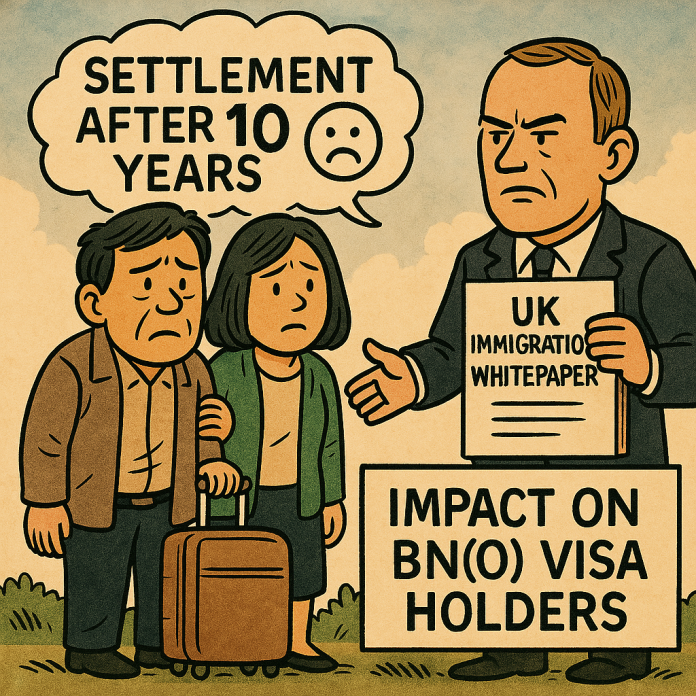
The UK government recently unveiled its Immigration Whitepaper, outlining significant changes to migration policies. Among the most notable proposals is the increase in the settlement qualifying period from five years to ten, alongside stricter English language requirements. While these measures aim to curb net migration, they have sparked uncertainty among British National (Overseas) (BN(O)) visa holders, particularly those from Hong Kong.

BN(O) Visa Holders in Limbo

Since the introduction of the BN(O) visa scheme in 2021, more than 163,000 Hongkongers have relocated to the UK. The visa was designed as a humanitarian pathway following Beijing’s imposition of the National Security Law in Hong Kong. However, the new immigration policies raise concerns about whether BN(O) holders will be subject to the extended settlement period and additional requirements.

Potential Challenges

  1. Extended Settlement Period – BN(O) visa holders previously expected to secure permanent residency after five years. If the new rules apply, they may need to wait a decade before obtaining settled status.
  2. English Language Tests – The government has proposed mandatory language assessments for immigrants and their adult dependents. This could pose challenges for BN(O) families who may not have anticipated such requirements.
  3. Economic Uncertainty – Many BN(O) holders moved to the UK seeking stability and opportunities. However, with rising unemployment and housing affordability issues, some are reconsidering their long-term plans.

Government’s Stance

Despite concerns, the UK government has reaffirmed its commitment to the BN(O) scheme, describing it as a special humanitarian pathway. However, officials have yet to clarify whether BN(O) holders will be exempt from the new restrictions. The uncertainty has led some Hongkongers to explore alternative migration options, including Canada, Australia, and New Zealand, which offer shorter settlement periods.

Looking Ahead

With the first BN(O) visa holders becoming eligible for settled status in January 2026, clarity on the policy changes is urgently needed. The UK government is expected to provide further details later this year, following a public consultation. Until then, BN(O) holders remain in a state of uncertainty, weighing their options and assessing the long-term viability of their British dream.

Trump vs. Harvard: A Clash of Ideologies and Power Struggles

0
Trump and Harvard

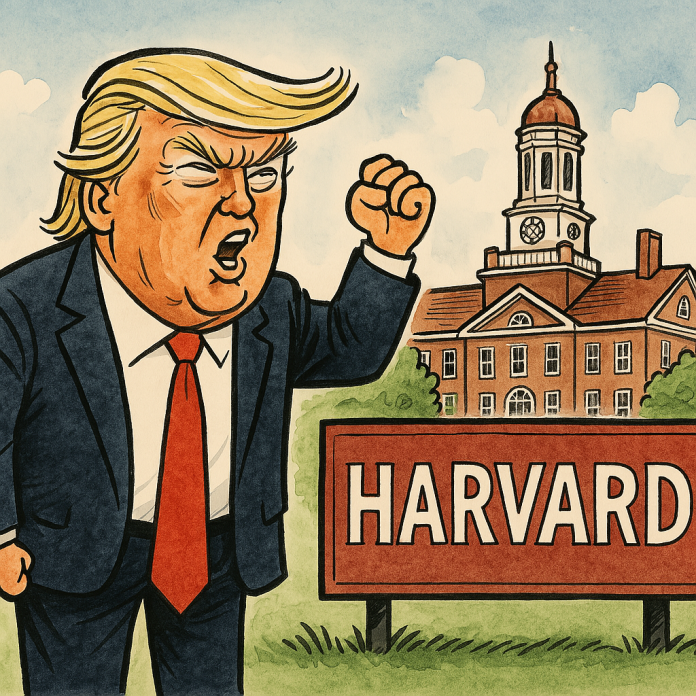
The relationship between Donald Trump and Harvard University has long been fraught with tension, but recent developments have escalated the conflict to unprecedented levels. Trump, known for his populist rhetoric and skepticism toward elite institutions, has increasingly targeted Harvard, accusing it of political bias, antisemitism, and excessive reliance on federal funding. His administration has taken aggressive steps to limit Harvard’s influence, including freezing billions of dollars in grants, restricting international student enrollment, and threatening to revoke its tax-exempt status2.

This ongoing battle between Trump and Harvard is not just about funding—it represents a deeper ideological struggle between conservative populism and academic liberalism, raising questions about government control over higher education, free speech, and the future of elite institutions in America.

Trump’s War on Harvard: The Key Issues

Trump’s recent actions against Harvard stem from multiple grievances, including:

  1. Federal Funding Cuts – Trump has proposed redirecting $3 billion in Harvard grants to trade schools, arguing that the university has become a hub for left-wing ideology and antisemitic protests.
  2. International Student Restrictions – His administration attempted to block Harvard from enrolling foreign students, citing concerns over national security and radicalization.
  3. Tax-Exempt Status Threats – Trump has suggested revoking Harvard’s tax-exempt status, claiming that the university misuses federal funds and discriminates against conservative viewpoints.
  4. Viewpoint Diversity Audits – His administration has pushed for investigations into Harvard’s hiring practices, aiming to increase ideological diversity among faculty and students.

These measures reflect Trump’s broader anti-elitist stance, positioning Harvard as a symbol of liberal academia that he believes undermines American values.

Harvard’s Response: Defending Academic Independence

Harvard has strongly opposed Trump’s actions, arguing that his administration is engaging in unconstitutional retaliation against the university. In response to the funding freeze and student enrollment restrictions, Harvard filed multiple lawsuits, claiming that Trump’s policies violate the First Amendment and due process rights.

Harvard President Alan Garber has condemned Trump’s efforts, stating that the administration’s actions are part of a broader attempt to control academic institutions and force them to align with government-approved narratives. The university has also emphasized its commitment to free speech, arguing that Trump’s accusations of antisemitism and radicalization are politically motivated rather than based on factual evidence.

Despite legal victories, Harvard remains under intense scrutiny, with Trump’s administration continuing to push for greater oversight and financial penalties against the university.

The Bigger Picture: Populism vs. Elite Academia

Trump’s battle with Harvard is not an isolated incident—it reflects a larger cultural and political divide in the United States. His administration has targeted multiple Ivy League institutions, including Columbia University, the University of Pennsylvania, and Cornell University, accusing them of liberal bias and failing to protect conservative students.

This conflict highlights the growing tension between populist movements and elite academic institutions, with Trump’s supporters viewing universities as out-of-touch politically biased, and disconnected from real-world concerns. Meanwhile, Harvard and other elite schools argue that academic freedom and intellectual diversity are essential to maintaining a strong democracy and informed citizenry.

The debate raises critical questions:

  • Should the government have the power to dictate university policies?
  • Is Harvard truly biased, or is Trump using it as a political scapegoat?
  • How will these tensions shape the future of higher education in America?

What’s Next for Trump and Harvard?

As Trump continues his second term, his administration is expected to intensify its efforts to reshape higher education policy. Harvard, on the other hand, will likely fight back through legal channels, defending its academic independence and financial stability.

The outcome of this battle could have lasting implications for universities across the country. If Trump succeeds in cutting funding, restricting student enrollment, and revoking tax exemptions, it could set a precedent for greater government intervention in higher education. Conversely, if Harvard prevails, it may reinforce the autonomy of academic institutions, ensuring that universities remain free from political influence.

Regardless of the final outcome, the Trump-Harvard conflict serves as a powerful example of the ongoing struggle between political authority and academic freedom, shaping the future of education, governance, and ideological discourse in America.

Raising Children in the Modern Era: Navigating AI, Globalization, Politics, and Philosophical Shifts

0
navigating AI

Raising a child in the 21st century is more complex than ever before, highlighting the challenges of parenting in the modern era. Parents today must navigate an evolving world shaped by artificial intelligence (AI), globalization, political tensions, ideological shifts, and rapidly changing philosophies. Unlike previous generations, today’s children are growing up in an environment where technology influences daily life, new-age thinking challenges traditional norms, and major global events impact their perspectives.

To raise well-rounded, resilient children in this era, parents must take an adaptable approach, equipping them with critical thinking, emotional intelligence, and ethical reasoning. This article explores key parenting strategies, addressing how AI, politics, wars, influential figures like Donald Trump, globalization, and philosophical changes impact child development.

Artificial Intelligence and Digital Upbringing

The rise of AI has transformed childhood in ways never before imagined. From virtual assistants and AI-powered learning tools to personalized algorithms and robotics, technology is increasingly shaping how children interact, learn, and perceive the world.

While AI provides valuable educational opportunities, it also presents challenges such as misinformation, excessive screen time, and reduced human interaction. AI-driven social media platforms expose children to biased content, digital distractions, and social comparison, affecting their mental health and sense of self-worth.

Parenting in the AI Age

To raise a child successfully in a digital world, parents should: ✅ Teach media literacy, helping kids distinguish credible sources from misinformation. ✅ Set screen-time boundaries, ensuring a healthy balance between technology and real-world experiences. ✅ Encourage creativity and human interaction, so children develop critical thinking skills and social intelligence. ✅ Discuss AI ethics, helping children understand privacy concerns, bias in algorithms, and responsible technology use.

Parents must ensure AI complements their child’s development without replacing essential human interactions and emotional intelligence.

New-Age Thinking and Shifting Philosophies

Traditional parenting approaches are being challenged by modern philosophical movements. With postmodernism, spiritual exploration, and non-traditional education models becoming widespread, children are increasingly exposed to self-directed learning, fluid concepts of identity, and progressive social ideologies.

While open-mindedness and self-exploration are valuable, they can sometimes lead to confusion, lack of structure, and difficulty forming strong principles. Parents must balance curiosity with grounding values, ensuring children think critically rather than simply adopt emerging trends without questioning them.

How Parents Can Raise Free Thinkers

�� Encourage thoughtful discussions, exposing children to multiple perspectives before they form their own conclusions. �� Teach emotional intelligence, helping kids build self-awareness, empathy, and resilience. �� Balance tradition and modernity, ensuring children understand historical lessons while embracing innovation. �� Promote rational inquiry, guiding children to seek evidence-based reasoning rather than blindly follow ideological trends.

By fostering both curiosity and intellectual discipline, parents can ensure their children develop independent thought and a strong sense of self.

Political Turbulence and Global Unrest

The modern world is rife with political conflicts, leadership crises, economic instability, and ongoing wars. Figures such as Donald Trump, political movements, and global conflicts influence how children perceive authority, justice, and leadership.

In an era where polarized opinions dominate media, children must learn to process information critically rather than absorb propaganda. Many young people struggle with stress and anxiety related to global events, especially when exposed to divisive rhetoric, violent conflicts, and economic uncertainty.

Helping Kids Understand Politics and Leadership

��️ Encourage civil discourse, teaching children to discuss differing views respectfully. �� Expose them to multiple perspectives, ensuring they analyze political events objectively. �� Teach media literacy, helping kids distinguish biased narratives from factual reporting. ❤️ Promote civic responsibility, encouraging participation in community initiatives and constructive activism.

Rather than imposing political ideologies, parents should guide children toward ethical, informed decision-making, equipping them to become responsible citizens.

Globalization and Cultural Adaptability

Due to globalization, children are now growing up in a more interconnected world. Exposure to different cultures, economic systems, and social movements has reshaped how young people view society, identity, and collaboration.

While globalization brings greater opportunities for international education, travel, and career growth, it also introduces new challenges such as cultural clashes, economic disparity, and ethical consumerism. Parents must ensure children develop cultural intelligence and adaptability, helping them thrive in diverse environments.

Raising Globally Competent Children

�� Introduce multicultural education, exposing kids to different traditions, customs, and histories. ��️ Encourage language learning, equipping children with skills to interact across cultures. �� Instill respect and inclusion, fostering understanding of different worldviews. �� Discuss global issues, teaching kids about climate change, economic injustice, and ethical responsibility.

By raising globally aware children, parents help them develop critical problem-solving skills and compassion, preparing them for a future shaped by international cooperation.

Parenting for the Future: Raising Resilient, Ethical Thinkers

In a world influenced by AI, political movements, wars, globalization, and shifting ideologies, parenting must focus on building strong foundational values. Raising emotionally intelligent, critically thinking, and ethical individuals is the key to helping children thrive in an unpredictable world.

Parents must instill: ✅ Analytical Thinking: Teaching children to question, evaluate, and make informed decisions. ✅ Emotional Strength: Equipping kids with resilience, mental wellness strategies, and coping mechanisms. ✅ Ethical Responsibility: Fostering integrity, compassion, and civic engagement. ✅ Technological Literacy: Ensuring children use AI responsibly while maintaining human connection.

Raising a child in this generation may be challenging, but with intentional guidance, parents can ensure they develop into thoughtful, empowered individuals who contribute to society with wisdom, empathy, and strength.

The Intersection of Artificial Intelligence and Psychology: Advancements, Challenges, and Future Possibilities

0
AI in psychology

Artificial Intelligence (AI) and Psychology have long been interconnected, with AI shaping the study of human behavior and psychology influencing the design of intelligent systems. As AI continues to evolve, it increasingly impacts various domains within psychology, from mental health care and behavioral analysis to cognitive modeling and ethical considerations. The interplay between these disciplines presents both opportunities and challenges, shaping the way individuals interact with technology and how technology influences human cognition and emotion.

AI in Psychological Research: A New Frontier

Psychologists have traditionally relied on observation, clinical studies, and statistical analysis to understand human behavior. However, with the advent of AI, researchers now have access to advanced computational models capable of analyzing vast amounts of psychological data with greater speed and accuracy. Machine learning algorithms can detect patterns in human emotions, predict behavior, and even simulate cognitive processes, enabling psychologists to refine theories and develop more precise interventions.

For example, AI-powered sentiment analysis tools allow researchers to examine social media posts, speech patterns, and facial expressions to understand emotional trends across populations. This has profound implications for mental health research, enabling early detection of conditions such as depression, anxiety, and stress. By integrating AI into psychological studies, researchers can gain deeper insights into individual and collective human experiences, facilitating more effective treatments.

AI in Mental Health: Revolutionizing Therapy and Diagnosis

One of the most promising applications of AI in psychology is its impact on mental health care. AI-driven platforms such as chatbots and virtual therapists have transformed the way patients access psychological support. These systems use natural language processing (NLP) and machine learning algorithms to interact with individuals, providing guided therapy, coping strategies, and emotional support.

AI-based mental health applications, like Woebot and Wysa, offer users real-time conversations with virtual assistants trained in cognitive behavioral therapy (CBT) techniques. These tools provide individuals with personalized emotional guidance, helping them manage stress, anxiety, and depression in ways that complement traditional therapy.

Furthermore, AI aids mental health professionals in diagnosing psychological disorders. Deep learning models can analyze brain scans, genetic markers, and behavioral data to detect neurological conditions such as schizophrenia, bipolar disorder, and autism spectrum disorder. By leveraging AI, psychologists can develop early intervention strategies, improving patient outcomes and increasing accessibility to mental health care.

Cognitive Science and AI: Understanding Human Thought

Cognitive psychology seeks to understand how people think, learn, and process information, and AI has become an invaluable tool in modeling cognitive processes. AI-driven systems simulate human decision-making, attention mechanisms, and memory retention, offering researchers deeper insights into how intelligence is structured and applied.

Neuroscientists use machine learning algorithms to study patterns in brain activity, identifying correlations between cognitive functions and neurological disorders. AI models can simulate the workings of the prefrontal cortex, memory formation, and problem-solving processes, allowing psychologists to refine theories about human cognition and intelligence.

Additionally, AI contributes to behavioral economics by analyzing consumer psychology and decision-making patterns. Retailers, advertisers, and social media platforms employ AI-driven analytics to predict purchasing behavior and user engagement, fine-tuning their strategies to align with cognitive biases and emotional triggers.

The Ethical Considerations of AI in Psychology

While AI offers immense benefits to psychology, it also raises ethical concerns, particularly regarding privacy, bias, and the human-AI relationship. AI systems that analyze human emotions, predict behavior, or provide psychological support must be designed with ethical safeguards to prevent manipulation and ensure patient confidentiality.

One major concern is algorithmic bias, which can impact AI-driven psychological assessments. If an AI model is trained on biased datasets, it may reinforce harmful stereotypes or produce inaccurate diagnoses. Psychologists and AI developers must work collaboratively to ensure that AI systems are transparent, fair, and representative of diverse populations.

Additionally, the increasing reliance on AI-powered therapists raises questions about human empathy and social connection. While AI can offer accessible mental health support, it lacks genuine emotional intelligence, potentially reducing the effectiveness of therapy in complex cases. Psychologists must carefully evaluate the role of AI in human interactions, ensuring that it complements traditional methods rather than replaces them.

AI-Assisted Personality and Behavioral Analysis

AI plays an essential role in personality assessment and behavioral prediction, aiding professionals in fields such as forensic psychology, talent acquisition, and leadership development. Machine learning models can analyze speech patterns, facial expressions, and social media behavior to assess an individual’s personality traits, emotional stability, and risk factors.

Forensic psychologists leverage AI-powered systems to profile individuals based on patterns in criminal behavior, helping law enforcement agencies anticipate potential threats. Similarly, AI-driven psychometric tests assist organizations in evaluating job candidates, ensuring better alignment between personality traits and professional roles.

However, concerns surrounding data privacy and autonomy persist. AI-based personality assessments must respect ethical guidelines, ensuring that individuals are not subjected to biased predictions or invasive evaluations.

The Role of AI in Human-AI Relationships and Social Psychology

As AI technologies become more sophisticated, they influence the way humans perceive relationships, attachment, and social interactions. AI-powered virtual companions, humanoid robots, and interactive assistants increasingly serve roles in education, caregiving, and emotional support, prompting psychologists to study the psychological effects of AI-human relationships.

For instance, robots designed for elderly care and companionship, such as Paro the therapeutic seal, provide emotional comfort for individuals experiencing loneliness or cognitive decline. AI-driven social assistants also play an essential role in autism therapy, helping individuals improve social skills and communication techniques.

However, as AI companions become more lifelike, researchers express concerns about emotional dependency and attachment. Some individuals may develop strong emotional bonds with AI systems, raising questions about the psychological impact of human-machine relationships and the potential replacement of human social connections.

AI and Psychological Warfare: Manipulation and Misinformation

AI’s involvement in psychological warfare, persuasion techniques, and misinformation is a growing concern in both psychology and security studies. AI-driven deepfake technology, social media algorithms, and political campaign strategies can manipulate public opinion, influence decision-making, and spread misleading information.

Social psychology experts study how AI shapes group behavior, persuasion techniques, and cognitive biases, identifying methods to combat misinformation and strengthen digital literacy. Governments and regulatory bodies are increasingly working to develop AI ethics policies, ensuring that technology is used responsibly and transparently.

The Future of AI and Psychology: Opportunities and Challenges

As AI continues to advance, its applications in psychology will expand, offering greater insights into human behavior, mental health, and cognitive processes. AI-assisted therapy, automated psychological assessments, and neuroscience-based computational models will contribute to better healthcare, education, and decision-making.

However, psychologists and AI developers must collaborate to address ethical challenges, ensuring that AI remains an enhancement rather than a replacement for human expertise. The future of AI in psychology lies in responsible implementation, fostering innovation while maintaining respect for human autonomy, emotional intelligence, and ethical considerations.

Ultimately, AI and psychology represent a powerful synergy, unlocking new possibilities for understanding and improving human thought, emotion, and behavior in an increasingly technological world.

Celebrating Excellence in Education: Honoring Oyenike Oluwatoyin Erimieleagbon

0
Oyenike

On May 21, 2025, the International Association for Quality Assurance in Pre-Tertiary & Higher Education (QAHE) proudly announced the awarding of the Doctor of Educational Leadership and Administration (Honoris Causa) to Oyenike Oluwatoyin Erimieleagbon. This esteemed honor was presented in collaboration with the American University of Business and Social Sciences (AUBSS), recognizing her remarkable contributions to the field of education.

Oyenike is a visionary leader with over 22 years of experience as both a lecturer and librarian. Her unwavering dedication to enhancing access to quality education has significantly impacted marginalized communities, positively transforming the lives of more than 1,000 students. Throughout her career, she has championed initiatives aimed at fostering good reading habits and improving literacy rates, demonstrating her commitment to educational equity and innovation.

The honorary doctorate acknowledges Oyenike’s extensive contributions to educational development, including the founding of programs that provide essential learning resources and support to students in need. Her work exemplifies a lifelong dedication to education and community service, making her a role model for aspiring educators and leaders alike.

QAHE congratulates Oyenike Oluwatoyin Erimieleagbon on this extraordinary achievement and looks forward to her continued influence in educational leadership and community development. Her recognition not only underscores her personal accomplishments but also highlights the vital role of educators in fostering positive societal change.

As QAHE remains committed to promoting quality and excellence in education, the recognition of outstanding individuals like Oyenike serves as a reminder of the transformative power of education.