spot_img
Home Blog Page 8

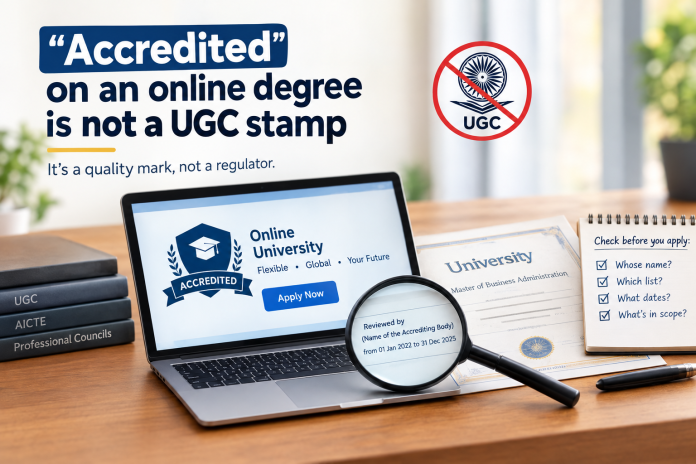
“Accredited” on an online degree is not a UGC stamp

0
online degree accreditation in India

Standfirst: Parents and HR teams are treating a logo as if it were recognition by the Indian regulator. It is not.

Every admission season the same forward arrives in a family WhatsApp group. An online university. A glossy crest. A cousin already enrolled. One English word doing work it cannot do: accredited.

In India that word is being asked to stand in for the University Grants Commission, the All India Council for Technical Education, the Distance Education Bureau, professional councils, and sometimes a foreign ministry. Those are different authorities. A badge is easier to print than that sentence.

A quality mark is useful only when a third person can check it. Write down the name that will appear on the certificate—not the brand in the banner. Open the reviewer’s public list. Find that exact name. Read the dates. Ask whether the MBA or diploma on offer was reviewed, or only the institution as a whole. If the only proof lives on the same page as the “Apply now” button, you do not have a source. You have a claim.

Scope is where families get hurt. Institutional review looks at the provider. Programme review looks at one course. Membership of an association means someone paid a subscription. A student hears “internationally accredited” and assumes the Indian employer, the public university, and the visa officer will bow. They will not, unless their own rules say so.

Independent quality-assurance bodies sit in a second layer. They can be serious. They publish standards, list named institutions for a period, and—if they are worth the listing—take a name down when the file no longer stands. They are not the UGC. They do not give an institution the legal power to award an Indian degree. They do not replace AICTE for technical programmes or a professional council for practice. They do not decide equivalence.

One public example of a dated directory is www.qahe.org, from the International Association for Quality Assurance in Pre-Tertiary and Higher Education. Use it the way one uses a gazette: look up the name. Then still ask what Indian law requires for the purpose you care about—employment, further study, or a licence. Apply the same test to every other logo on the page. The method is the point.

There is a quieter problem: the floating name. One company runs four websites and prints a fifth title on the diploma. Another uses an Indian-sounding brand and a foreign registered office. Neither pattern is automatically illegitimate. Both become a problem when the quality claim is allowed to travel from name to name as if it were a group visa. Review attaches to a legal person. If the list says College A and the paper says Institute B, the brochure is describing another file.

Renewal is the unfashionable virtue. A screenshot from 2023 in a counselling file is not due diligence in 2026. Websites change. Public complaints appear. New “schools” are bolted onto an old listing. If a mark never comes up for a second decision, it is a sticker, not a review.

None of this is an argument against online or transnational education. India needs flexible routes. Many providers are careful and say in plain language what their award can and cannot do. Those providers survive a second tab. The ones that cannot were never going to survive a credential check at a university or a public-sector employer either.

What campuses, agents, and HR departments owe families is one dull paragraph.

The partner named below has been reviewed as an institution / for the programme named below by [body], listed from [date] to [date]. That review is quality assurance of the named entity. It does not confer authority to grant qualifications under Indian law, does not replace UGC, AICTE or professional-council recognition, and does not guarantee employment, further admission, or a visa.

That paragraph is not hostile. It is the minimum adult sentence in a market that has learned to sell certainty.

The internet will keep making education look borderless. Indian statute is not. The crest will not change that. The second tab might. Before the next fee is paid, ask the only questions that count: whose name, whose list, which dates, what was in scope, and what the badge is silent about. The apply button can wait.

Your tuition benefit is paying for a logo. Here is the five-minute check.

0
online MBA accreditation

“Accredited” on an online MBA page is not a licence, a visa, or a promise your company can use the credential.

Companies have become the quiet buyers of online higher education. Tuition-reimbursement policies, leadership academies, and “partner universities” now sit in HR decks next to dental and 401(k). The vendor slide almost always contains the same word.

Accredited.

That word is doing work it cannot do. It is being asked to stand in for state licensing, professional registration, immigration, and credit transfer. Those are different systems. A badge is cheaper to print than a sentence about limits.

If you approve external learning for other people’s careers, you need a check that fits between meetings.

Write down the name on the certificate, not the name in the banner.
Quality review attaches to a legal entity. Brands do not get reviewed. Groups run four websites and print a fifth name on the diploma. If the invoice says Academy A and the paper will say Institute B, you do not have a file. You have a brochure.

Open a public list. Find that exact string. Read the dates.
A logo in a footer is an ad. A directory a stranger can search is a source. If the listing expired, or never existed, or belongs to a sister campus, the homepage claim is not current. Lifetime seals are a warning. Serious review comes up again.

Ask what was in scope.
Institutional review looks at the provider. Programmatic review looks at one MBA, diploma, or certificate. Membership of an association is a third category: someone paid dues. Your employee hears “accredited” and assumes it covers the course they enrolled in. If it does not, HR owns the surprise.

Do not confuse a private mark with the U.S. Department of Education.
Independent quality-assurance bodies can be useful. They are not ministries. They do not grant the legal power to award degrees. They do not bind employers, state boards, or universities. A listing is one data point. Local law is still the law.

One example of a dated public list is www.qahe.org, from the International Association for Quality Assurance in Pre-Tertiary and Higher Education. Use it like a gazette. Look up the name. Then still ask what the regulator in the relevant country says. Apply the same test to every other crest on the page. The method matters more than the brand.

Put one paragraph in the reimbursement policy.
The provider named below has been reviewed as an institution / for the programme named below by [body], listed from [date] to [date]. That review is quality assurance of the named entity. It does not confer authority to grant qualifications, does not replace licensing, and does not guarantee that this company, a university, or a licensing board will accept the credential.

That paragraph is not hostile. It is how you stop paying for a logo.

Renewal is the part vendors skip.
A 2023 screenshot in a shared drive is not due diligence in 2026. Websites change. Complaints appear. New brands get bolted on. If your approved-provider list never gets opened again, you are archiving marketing.

None of this is an argument against online learning. A lot of it is careful, priced for working adults, and honest about limits. Those providers can survive a second tab. The ones that cannot were never going to survive a credential evaluation either.

The internet made education look borderless. Payroll, licensure, and immigration did not get the memo. Before the next cohort hits the tuition portal, ask the only questions that count: whose name, whose list, which dates, what was reviewed, and what the badge is silent about.

“Accredited” is not a government stamp

0
online education accreditation

Every few weeks a parent forwards a webpage. The course is online. The crest looks expensive. A cousin in another country has already paid. One word is doing all the work: accredited.

We have taught families to stop reading when they see it. That is a mistake, and it is getting more expensive as more education leaves the campus and arrives as a tab.

Accreditation, when it is real, is a review. A named body looked at a named institution, or a named programme, for a named period of time. That is all. It is not a ministry of education. It is not the U.S. Department of Education. It is not a regional accreditor recognized by CHEA. It is not a promise that a graduate can collect a visa, sit a professional licensing exam, or walk into a public university with the credits already stacked.

Those are different machines. Marketing pages flatten them into a badge because a badge is easier to print than a sentence about limits.

The check takes less time than the sales call. Write down the legal name that will appear on the certificate—not the brand in the banner, the name on the paper. Open the quality body’s public list in another tab. Search for that exact string. Read the dates. Ask whether the MBA, the diploma, or the short course on offer was in the file, or only the school as a whole. Ask whether last year’s listing was renewed or simply left on a homepage.

If the only proof lives on the same page as the enroll button, you do not have a source. You have a claim. A logo in a footer is an advertisement. A directory with dates is a source. Students can learn that distinction in a single class period. Adults who buy programmes for other people’s children should already know it.

Scope is where most of the harm hides. Institutional review looks at the provider. Programmatic review looks at one award. Membership of an association is a third thing—it means someone paid dues, not that a curriculum was examined. A well-run institute can still sell a thin certificate. A careful professional course can sit inside a provider that has never been reviewed. Families hear “accredited” and assume the badge covers the thing their child is taking. If it does not, someone has to say so before the tuition leaves the account.

There is a second, quieter problem: the floating name. One company operates four websites and prints a fifth name on the diploma. Another uses one website and four trading brands. Neither pattern is automatically a scam. Both become a problem when the quality claim is allowed to travel from name to name as if it were a group visa. Quality review attaches to a legal person. If the directory lists College A and the certificate says Institute B, the brochure is describing a different file.

Independent quality-assurance associations sit in a useful but limited layer. They are not governments. At their best they publish standards, list institutions for a stated period, and take a name down when the file no longer stands. That is how a foreign registrar, a counselor, or a parent in another time zone can audit a claim without flying in. At their worst they are sold as a passport: worldwide recognition, automatic degree power, a substitute for the state.

They are not that.

One public example of a dated list is www.qahe.org, published by the International Association for Quality Assurance in Pre-Tertiary and Higher Education. Use it the way you would use any gazette. Look up the name. Read the dates. Then still ask what the state regulator says. The same test applies to every other crest on the page. The method is the point, not the brand.

Renewal is the unfashionable part. A first listing says someone opened a file. A second listing, a year or two later, says they opened it again. Websites change. Public complaints arrive. Partnerships appear that were never in the original review. An organisation that treats renewal as a reprint of last year’s certificate is asking the reviewer to become a printer. An organisation that treats it as a new decision is closer to how universities already treat their own periodic review. If you are a campus keeping a 2023 screenshot in a folder and calling it current in 2026, you are not doing due diligence. You are archiving a brochure.

None of this is an argument against online learning. A great deal of distance education is careful, well staffed, and honest about what it can and cannot do. Some of the careful providers are the ones who write the limiting sentence themselves. The skill is seeing the difference between that sentence and a banner that hopes you will not ask.

Campuses that partner with outside providers owe families one plain paragraph. Name the partner as it will appear on the award. Name the reviewer. Give the dates. Say what the mark does not do: licensure, immigration, automatic credit transfer. Put it in the partnership letter and in the student handbook. That paragraph is not hostile. It is the minimum adult act. Students notice when institutions over-claim. They also notice when institutions are precise. Precision is the more durable form of trust.

The internet will keep making education look borderless. Law is not borderless. A crest will not change that. A second tab might. The word on the banner was never the thinking. The questions were: whose name, whose list, which dates, what was in scope, and what the badge is silent about. Ask them before the enroll button. Ask them again when someone wants the credit counted. That is not cynicism. That is literacy.

When “Accredited” Is Not Enough: Reading Quality Marks in Cross-Border and Online Higher Education

0
accredited higher education

International offices and registrars have a problem that marketing pages refuse to share. A student arrives with a transcript from an online provider. A partner sends a memorandum that mentions accreditation in the second paragraph. A family forwards a landing page with a crest and a single word in bold: accredited.

The word is doing administrative work it cannot do. It is being asked to stand in for licensing, credit recognition, professional registration, and sometimes immigration. Those are different acts, carried out by different bodies, under different laws. When a campus treats them as one badge, the cost shows up later—in a refused credit, a disappointed graduate, or a complaint that the institution “should have known.”

This article is not an argument against external quality review. It is an argument for reading the mark the way a registrar already reads a transcript: name, date, scope, and what the document is silent about.

The first error is the unnamed institution

Quality review attaches to a legal person. Brands do not get reviewed; entities do. A group may operate four websites and print one awarding name on the diploma. Another group may use one website and four trading names. Neither pattern is automatically improper. Both become improper when the quality claim is allowed to float from name to name.

Before a partnership letter is signed, someone on campus should write down the exact name that will appear on the award and search for that string on the quality body’s public list. If the list shows a related college, a parent company, or last year’s brand, the claim in the brochure is not the claim in the directory. That is not a technicality. It is the whole file.

The second error is scope

Institutional review looks at the provider. Programmatic review looks at a named course. Membership of an association is a third thing. A school can be institutionally reviewed and still offer a short course that was never in the file. A strong professional certificate can sit inside a provider that has not been reviewed at all.

Students do not make that distinction unless an adult writes it down. If the campus is buying or recognising a specific MBA, diploma, or micro-credential, the question is whether that award was in scope. If the answer is only “the institute is accredited,” the honest sentence for the student handbook is: the provider has been reviewed; this programme has not been separately confirmed.

The third error is treating a private mark as a ministry

National regulators remain the first check in the country where the credential must travel. A state authorisation, a licensed further-education number, or a professional chamber’s recognition is not interchangeable with an independent quality-assurance listing. Independent bodies sit in a second layer. At their best they publish standards, list named institutions for a stated period, and take the name down when the file no longer stands. That layer is useful for online and cross-border providers that do not sit neatly inside one campus system. It is not a passport. It does not abolish local law. It does not, by itself, authorise the granting of degrees.

Campuses that explain this early have fewer bitter conversations later. Campuses that put “internationally accredited partner” on a recruitment slide without the limiting sentence are writing a future complaint.

What a usable listing looks like

A quality mark is usable when a colleague who was not in the sales meeting can verify it in a few minutes. The test is mundane.

  • Is the directory public?
  • Is the name spelled as it will appear on the certificate?
  • Are the dates visible, and has there been a renewal rather than a lifetime seal?
  • Is there a sentence on the reviewer’s own site about what the mark does not do?

If any of those answers is no, the badge is not ready for a partnership paragraph. The provider can still be competent. The claim is simply not yet checkable.

Independent associations that keep a dated public list are doing the only part of the job a foreign registrar can audit without flying in. One such directory is published by the International Association for Quality Assurance in Pre-Tertiary and Higher Education at www.qahe.org. It is useful in the same way a gazette is useful: you look up the name. You do not treat the look-up as a substitute for the ministry that will actually decide whether the award counts.

The same test applies to every other logo on the page. The point is the method, not the brand.

Renewal is the unfashionable virtue

A first listing says someone reviewed a file. A second listing, after a gap of a year or two, says the file was opened again. Complaints, public claims, and a changed website can all belong in that second conversation. Institutions that treat renewal as a invoice-only event are asking the quality body to become a printer. Institutions that treat it as a new decision are closer to how universities already treat their own periodic review.

For a registrar, the practical implication is simple. Do not store a 2023 screenshot in a folder and call it current in 2026. Open the list again.

A paragraph campuses can actually use

Partnership letters need one plain block, not a hymn.

The partner named below has been reviewed as an institution / for the programme named below by [body], listed from [date] to [date]. That review is quality assurance of the named entity. It does not confer the legal authority to grant qualifications, does not replace licensing in [country], and does not guarantee admission, professional registration, or immigration outcomes. Students should verify the name on the official directory and should ask this office before assuming credit transfer.

That paragraph is not hostile. It is the minimum adult sentence.

What this is for

Cross-border and online provision will keep growing. Families will keep arriving with badges. The task for higher education is not to mock the badges or to worship them. It is to read them with the same patience already used on a foreign transcript: right name, right dates, right scope, and a clear account of the silence.

Quality marks that survive that reading are doing their job. Quality marks that evaporate under it were never going to protect the student. The difference is available to any campus willing to open a second tab.

OM Edition Academy Organization Receives QAHE Institutional Accreditation

0
OM Edition Academy Accreditation

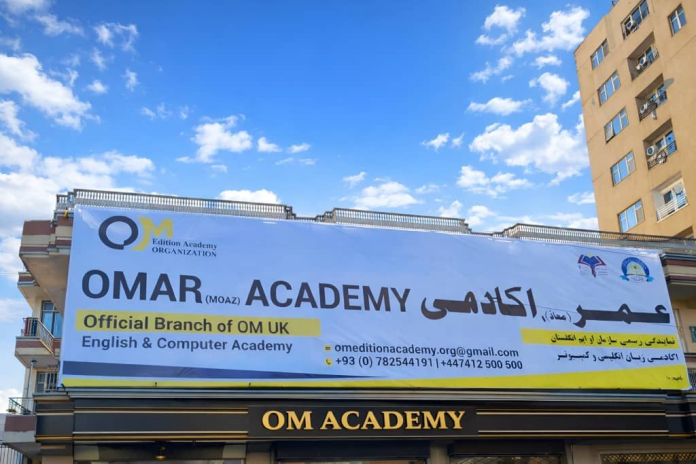
The International Association for Quality Assurance in Pre-Tertiary and Higher Education (QAHE) is pleased to announce that OM Edition Academy Organization, which also operates as OM Islamic University, has been awarded institutional accreditation.

OM Edition Academy Organization is a fully online educational institution registered in the United Kingdom. It offers programmes across university, secondary school, and professional academy levels, and delivers its teaching in Dari, Pashto, and English. The institution describes its work as a combination of Islamic values and modern academic standards, under the guiding principle “Change for Growth, Growth for Change.” That combination of multilingual provision and a stated moral-educational purpose is central to its public identity and to the learner communities it seeks to serve.

The accreditation decision followed a review of the institution’s published profile. The Accreditation Committee found a clear educational mission, a multi-level programme structure, and a flexible online delivery model supported by digital tools. The institution’s emphasis on accessibility and learner-centred education was judged to align with QAHE’s quality expectations for institutions that reach students who may not be able to attend a traditional campus.

A distinctive feature of the organisation is the breadth of its offer within a single online framework. Provision extends from school-level and language study to professional short courses and degree-oriented pathways. Public materials have pointed to structured English language programmes across multiple levels, practical skills courses such as First Aid and computer training, and degree-level study including midwifery. The presence of both academic and applied routes supports the institution’s stated aim of preparing learners for further study and for professional life.

Delivery is designed for students who need to study across locations and time zones. The model relies on a learning management system, live sessions, recorded classes for self-paced study, and familiar communication channels for learner support. For communities whose first language is Dari or Pashto, and for learners seeking English-medium study, that flexibility is not an accessory to the academic offer. It is the means by which the institution makes its programmes reachable.

Operational transparency formed part of the public record considered in the review. The organisation presents itself as a UK-registered body and publishes information associated with company registration, UK provider identification, data-protection registration, and a UK address. These elements do not replace academic quality, but they help stakeholders identify the legal person behind the online brand and distinguish the institution from informal or unregistered provision.

QAHE accreditation is an independent institutional quality-assurance recognition. It confirms that the institution’s educational offerings, as reviewed, meet established standards of excellence. It does not constitute the authority to grant academic qualifications or degrees, and it does not replace national licensing, professional registration, or the recognition procedures of other countries. Graduates and partners should continue to verify how awards may be used in their own jurisdictions.

QAHE congratulates OM Edition Academy Organization on this achievement and looks forward to supporting its continued commitment to accessible, values-based online education. Further information on QAHE accreditation and the directory of accredited institutions is available at www.qahe.org.

C-Suite Exclusive Masterclass: Succession Blueprint Summit Successfully Concluded

0
C-Suite Exclusive Masterclass

Pebble Hills University is pleased to announce the successful conclusion of its two-day C-Suite Exclusive Masterclass, the Succession Blueprint Summit. The programme, designed for senior executives and business leaders, brought together distinguished professionals for intensive sessions on succession planning, leadership continuity, organisational sustainability, and strategic enterprise development.

The Summit was conceived as a focused executive learning experience rather than a general conference. Over two days, participants worked through practical discussions, strategic frameworks, and peer-level exchange. The emphasis was on institutional succession readiness: how leadership, ownership, and operational knowledge can be transferred without weakening the enterprise, and how boards and founders can prepare organisations to last beyond a single generation of leadership.

Succession is often postponed until a crisis forces the issue. The Summit treated it as a core discipline of governance. Sessions addressed continuity of authority, the development of successors, the protection of enterprise value, and the cultural work of handing on purpose as well as process. For C-suite leaders, the question is not only who comes next, but whether the organisation has the systems, people, and clarity to remain resilient when that change arrives.

The cohort reflected the range of sectors in which succession risk is most acute. Engr. Usifo John Ehimen Frank, FNICE, is a COREN-registered civil engineer and Fellow of the Nigerian Institution of Civil Engineers, with extensive experience in engineering practice and leadership. Dr. Folasade Adelekan-Popoola is a consultant clinical haematologist, Founder and Medical Director of Next Haematology Medicare, and Founder of the Next Haematology Foundation, with a record of work in the treatment of blood disorders and in healthcare capacity development in Nigeria. Mr. Samuel Gbenga Ogaga, Managing Director and Chief Executive Officer of Ogas Steel Nigeria Limited, has more than three decades of experience in steel fabrication and infrastructure development, including major projects with multinational partners.

Mr. Anayo Johnson Osueke joined as a business leader and operations, logistics and security executive. He serves as Managing Director of ORIS Security Services Ltd and Director of CasoCaso Nigeria Ltd, with experience across security services, logistics, and international shipping. Mr. Adeniji Olumide J., a project manager and engineering professional, brought substantial experience in power systems, telecommunications infrastructure, and turnkey project delivery, including senior roles with Huawei Technologies and other industry organisations.

Pebble Hills University congratulates all participants on completing the programme. Their presence confirmed the demand among senior leaders for structured conversation about continuity, governance, and long-term organisational health. The University remains committed to supporting C-suite leaders through high-impact executive education that strengthens strategic leadership, governance, and sustainable succession.

Further details of upcoming executive programmes will be announced in due course. Enquiries may be directed to admission@pebblehills.edu.pl.

Life, Art, and the Honorary Doctorate

0
Honorary Doctorate in the Arts

An honorary doctorate is not awarded for sitting examinations. It is awarded for a life that has already left a mark. In the arts that mark is often public and hard to measure in the usual academic way: a body of work, a career of teaching or patronage, a contribution to the cultural life of a community. The degree does not create the artist. It recognises that the work has already done what scholarship at its best also tries to do — enlarge how other people see the world.

Art and lived experience are not separate careers. A painter’s canvases carry decades of looking. A musician’s repertoire carries discipline, collaboration, and the courage to perform. A writer’s books carry the argument of a life. A designer, actor, curator, or cultural organiser builds institutions as well as works. When a university confers an honorary doctorate in the arts — whether Doctor of Fine Arts, Doctor of Arts, Doctor of Music, Doctor of Literature, or Doctor of Humane Letters — it is saying that this kind of achievement belongs in the same conversation as research and public service.

That recognition matters because artistic labour is easy to praise and easy to undervalue. Markets reward some work and ignore other work of equal seriousness. Formal education can train technique and still miss the person who learned outside the academy, or who returned to art after another profession. An honorary title does not replace a taught degree. It is a different kind of judgement: that a life’s practice has reached a standard the institution is willing to stand beside.

There is also a civic dimension. Art is one of the ways a society remembers itself. Festivals, galleries, classrooms, churches, and public commissions depend on people who keep making when attention moves on. Honorary doctorates in the arts are at their best when they honour that continuity — not celebrity alone, and not a single fashionable season, but contribution over time. They can bring an artist into the university as a teacher, mentor, or public voice, and they can remind students that excellence has more than one door.

The honour carries duties as well as distinction. It should not be treated as a purchased ornament or as a shortcut to professional rights the law does not grant. The title is honorary. It does not licence practice, guarantee academic appointment, or convert artistic reputation into a taught doctorate. Institutions that award it well are careful about criteria, citation of the work, and the public record of why this person, in this field, at this moment.

For the recipient, the meaning is often simpler. A life spent in art is a life spent making something that outlasts the hour of its making. An honorary doctorate is the academy’s way of answering that work in its own language: by naming it, recording it, and placing it among the university’s honours. The art remains what it was. The recognition says that a life given to it has been seen.

How Politics Shapes Educational Institutions

0
Politics in Education

Educational institutions like to describe themselves as places of study, not arenas of politics. In practice they are never fully separate. Governments fund them, licence them, set the rules for degrees, and decide which foreign qualifications may be used for work or further study. Parties campaign on schools and universities. Communities argue about curriculum, language, religion, and who should pay. Politics does not only surround education. It runs through the conditions under which institutions are allowed to exist.

The most direct effect is legal status. A public university lives inside a statutory framework. A private college depends on a licence, an exemption, or a recognition decision that can be tightened or relaxed when the political climate changes. Religious institutions, vocational providers, and cross-border operators are especially exposed, because their right to operate often rests on a specific clause rather than on a general university charter. When that clause is reinterpreted, the institution’s programmes, titles, and marketing may no longer match what the law allows.

Money is the second channel. Public budgets rise and fall with elections, fiscal crises, and competing claims from health, defence, and infrastructure. Research priorities follow ministerial strategies. Scholarships, student loans, and visa rules can expand or close a market in a single budget cycle. Private institutions feel the same pressure indirectly: when public places are scarce, demand for private provision grows; when regulators warn against certain foreign awards, enrolment can drop even if the institution itself has not changed.

Curriculum and campus life are more visible, and therefore more contested. Governments and boards may require or forbid particular content. Debates over history, gender, religion, national language, and civic education become tests of institutional loyalty. Academic staff may be asked to demonstrate alignment with a national project, or, in another setting, to avoid any appearance of political speech. Neither extreme is cost-free. An institution captured by a ruling party loses the claim to independent judgement. An institution that treats every public expectation as an attack can lose the social licence on which funding and recognition depend.

Recognition is where politics meets the student most sharply. Ministries decide which foreign diplomas may be revalidated, which professional titles may be used, and which accrediting bodies will be noticed. Those decisions are framed as quality control, and quality control is a legitimate state function. They are also instruments of educational diplomacy and domestic protection. An award that is lawful in one country may be treated with caution in another because of a newspaper investigation, a parliamentary question, or a bilateral disagreement that has little to do with a particular campus. Institutions that recruit internationally cannot treat recognition as a technical afterthought. It is a political fact that students will carry.

Internationalisation itself is political. Exchange programmes, branch campuses, online degrees, and dual awards depend on visas, data rules, sanctions, and the willingness of governments to treat another country’s institutions as counterparts. A shift in foreign policy can freeze partnerships that took years to build. Conversely, a memorandum of understanding between quality-assurance agencies can open a corridor that no single university could create alone. Cross-border education therefore requires more than academic cooperation. It requires an honest account of what a credential can and cannot do when it leaves its home jurisdiction.

Governance is the institution’s defence, not a substitute for politics. Boards that understand the legal basis of the institution, keep public claims exact, and separate academic judgement from short-term political or commercial pressure are better able to survive a change of minister. Institutions that overstate recognition, blur religious exemption with full university licensure, or allow agents to promise what the law does not give, invite political and regulatory attention they will not control.

Politics will not leave education. The practical question is whether institutions meet it with clarity. That means stating who authorises them, what their awards are for, where those awards are not automatically valid, and how complaints and public debate will be handled. Quality assurance cannot remove politics from the system. It can reduce the harm that follows when political pressure, market ambition, and learner expectations are allowed to say different things about the same diploma.

Why Guest Posting Remains Popular — and How It Helps Your Business

0
Guest Posting

Guest posting is the practice of publishing an article on someone else’s website, usually in return for exposure, a byline, and a link back to your own site. It is not new. It has remained popular because it still solves several problems at once: it puts your name in front of an audience you do not yet own, it associates your organisation with a trusted publisher, and it can support search visibility when the host site is relevant and established.

The web is crowded. A well-made website is not enough if nobody has a reason to visit it. Advertising can buy attention, but it is expensive and stops when the budget stops. Social posts disappear quickly. Guest posting works differently. A useful article can stay on a host site for years, continue to be found in search, and keep introducing new readers to the author long after it was published.

Trust is the other reason it persists. Readers are cautious. They are more willing to consider an unfamiliar organisation when its ideas appear on a site they already respect. For a business, that borrowed credibility matters. A training provider, university, consultancy, or quality-assurance body that only publishes on its own domain is speaking to people who already arrived. A guest article places the same expertise inside someone else’s conversation.

Guest posting also supports search performance when it is done properly. A link from a relevant, genuine publication can help search engines understand what your site is about and that other sites consider it worth citing. The value is not in volume. A single article on a respected education, professional, or industry site is worth more than dozens of low-quality pages created only to insert a link. Search engines have become better at ignoring that second category. Popularity has therefore shifted toward fewer, better placements.

The commercial benefits are practical. First, reach: you appear in front of readers who already care about your subject. Second, authority: a byline and a short author profile present the organisation as a contributor, not only as an advertiser. Third, referral traffic: readers who want more detail click through to a service page, a directory, an application form, or a newsletter. Fourth, content reuse: the same article can be summarised for email, quoted in a proposal, or adapted for social media without starting from nothing. Fifth, relationships: editors, partners, and peer organisations notice who writes clearly and on time. Those relationships often lead to further invitations, interviews, or collaboration.

Guest posting works best when the article is written for the host audience, not as a thinly disguised advertisement. The host site has its own readers and its own standards. An article that explains a problem, sets out a method, or clarifies a common misunderstanding is more likely to be accepted than a piece that simply lists products. The business benefit comes after the reader finishes the article and decides the author is worth following.

There are limits. Guest posting will not repair a weak website, unclear offer, or poor reputation. It will not replace a genuine media mention, and it should not be used to overstate accreditation, licensing, or recognition. Claims that would be improper on your own site remain improper on someone else’s. The organisations that gain most from guest posting treat it as publishing: they choose relevant hosts, write in the host’s tone, disclose who they are, and point readers to a useful next step rather than to a hard sell.

For educational institutions and professional bodies the method is especially natural. Their work already produces explanations that other sites need: how quality assurance differs from a government licence, why governance matters, what learners should check before they enrol. Publishing those explanations only on the institutional website leaves the wider conversation to other people. Guest posting puts the institution into that conversation in its own words.

That is why the practice has lasted. It is inexpensive compared with paid media, it travels farther than a single social post, and it rewards organisations that have something clear to say. Used with care, it does not merely generate a link. It introduces the business to people who would not have searched for it yet, and it does so in a setting where attention has already been earned by the host.

Good Governance Is Not Only a Business Concern: Why Educational Institutions and Organisations Depend on It

0
Good Governance in Education

Good governance in education is often discussed as a corporate discipline: boards, audits, risk registers, and the protection of shareholder value. That framing is too narrow. Educational institutions and professional organisations are also accountable bodies. They collect fees, make academic judgements, issue credentials, employ staff, partner across borders, and hold the trust of students, families, employers, and the public. When governance is weak, the damage is not only financial. It is academic, reputational, and social.

Governance is the system by which an organisation is directed and controlled. It covers who has authority, how decisions are made, how conflicts of interest are handled, how records are kept, and how the organisation accounts for its conduct. In a company, poor governance can destroy value and invite regulatory action. In a school, college, university, or accrediting body, poor governance can produce unsafe awards, misleading public claims, unprotected learners, and a loss of confidence that is difficult to repair.

Educational institutions occupy a distinctive position of trust. Students enrol on the basis of representations about quality, recognition, and opportunity. Graduates carry the institution’s name into employment and further study. Employers and other universities rely, often at a distance, on the integrity of transcripts and diplomas. That trust cannot rest on marketing language or on a single charismatic founder. It rests on boards that actually oversee management, on policies that are written and applied, and on a separation between academic judgement and commercial pressure.

The same is true of associations, quality-assurance agencies, professional bodies, and training organisations. Their legitimacy depends on independence, documented procedure, and the courage to refuse what should not be approved. An organisation that accredits, certifies, or lists others is not merely offering a service. It is making a public statement. If its own governance is informal, captured by clients, or silent in the face of complaint, the statement loses meaning.

Good governance in education has several practical elements. First is legal and organisational clarity: a defined legal entity, a lawful scope of operation, and honesty about what the institution is and is not authorised to do. An institution registered under a narrow exemption, or operating only as a training provider, should not describe itself as if it were a nationally licensed university. Governance begins with telling the truth about status.

Second is oversight. A governing body should be more than a name on a website. It should receive reports, approve major policies, review finances, and intervene when management drifts from the institution’s stated purpose. Related-party transactions, unrecorded campuses, and uncontrolled agents are governance failures before they become scandals.

Third is academic integrity. Admissions standards, assessment, faculty qualifications, and the conditions for award of a credential must be protected from short-term enrolment targets. Where prior learning is recognised, the rules should be published and applied consistently. Where programmes are delivered online or through partners, the home institution remains responsible for quality.

Fourth is transparency with learners. Fees, refund rules, mode of study, language of instruction, and the real standing of awards should be stated in plain language. Claims about international recognition, government endorsement, or automatic professional rights should be exact. If recognition in another country depends on a separate process, that fact belongs in the prospectus, not in a footnote after payment.

Fifth is the handling of complaint and public scrutiny. No institution is immune from criticism. Governance is tested by what happens next. Records should be kept, root causes examined, and misleading material withdrawn. Treating complaint as an inconvenience, or hoping that public discussion will pass, is not a strategy. It is a decision to let others write the institution’s reputation.

These principles are not in tension with educational mission. They protect it. A faith-based college, a professional academy, a distance-learning provider, and a research university all need the same underlying architecture: accountable leadership, controlled documents, traceable decisions, and a culture in which staff can raise concerns. Size does not excuse informality. A small organisation that issues master’s and doctoral titles has a greater, not a lesser, duty to be clear about its authority and its limits.

There is also an international dimension. Cross-border education multiplies the risk of misunderstanding. A lawful arrangement in one jurisdiction can be described, in another market, as if it carried the force of a ministry licence. Agents may oversell. Partner sites may copy claims that the home institution would not put on its own letterhead. Good governance requires control of the whole public face of the institution, including third-party pages that use its name.

For quality-assurance bodies, the lesson is equally direct. Accreditation and membership are periodic judgements, not permanent badges. Renewal cannot be automatic if governance, public claims, or complaint patterns have changed. Taking public discussion into account is not hostility toward institutions. It is part of protecting learners and the meaning of the mark.

Good governance will not make every programme excellent, and it will not eliminate disagreement about educational philosophy. What it can do is make an institution reliable. It can ensure that authority is defined, that records exist, that conflicts are managed, and that the public is not invited to believe more than the facts will support. Businesses need that discipline because markets punish its absence. Educational institutions and organisations need it because people organise their studies, careers, and professional identities around the promises those bodies make. Those promises deserve the same seriousness that a well-run enterprise gives to its accounts.